


- Mezzanine Floors
- Self-Storage Units
- Racking & Shelving
- Custom Fabrications
SEMA Racking Inspections Explained: What UK Warehouse Operators Need to Know
read

Warehouse racking systems operate under significant load day in, day out. Forklift trucks manoeuvre at pace, pallets are loaded and unloaded hundreds of times, and the inevitable result is wear and tear - sometimes minor, occasionally serious. Left unchecked, damaged racking poses a real risk to stock, staff, and your business.
This is why regular racking inspections are not optional. Under UK law, warehouse operators have a legal duty to ensure their racking is maintained in a safe condition and inspected at appropriate intervals. The consequences of failing to meet this obligation can be severe - from invalidated insurance policies to substantial HSE fines and, in the worst cases, prosecution following a serious incident.
This guide explains everything you need to know about SEMA racking inspections in the UK: the legal requirements, what inspectors check, how the traffic light risk system works, and how to prepare your warehouse for an inspection. If you operate a warehouse with pallet racking, longspan shelving, or any other storage equipment, this is essential reading.
The Legal Requirements for Racking Inspections in the UK
Warehouse racking is classified as work equipment under the Provision and Use of Work Equipment Regulations 1998 (PUWER). PUWER places a clear legal duty on employers to ensure that all work equipment is safe for use, maintained in a safe condition, and inspected to verify it has been correctly installed and does not subsequently deteriorate.
Beyond these general requirements, the Health and Safety Executive’s guidance document HSG76 - ‘Warehousing and storage: a guide to health and safety’ - sets out more specific rules for racking systems. HSG76 makes it clear that a more thorough expert inspection should supplement regular in-house inspections, carried out at 12-month intervals by a ‘technically competent person’ and accompanied by a detailed written report.
It is worth noting that whilst HSG76 is guidance rather than statute, it represents the HSE’s view of what good practice looks like. In the event of an incident, failing to follow HSG76 guidance will be taken as evidence that you did not discharge your duties under PUWER. The practical effect is that annual expert inspections are, for all intents and purposes, mandatory.
SEMA - the Storage Equipment Manufacturers’ Association - is the UK’s trade body for the racking industry. SEMA is not a regulator, but it is widely recognised as setting the industry standard for racking design, racking installation, and inspection. SEMA advocates a rigorous approach: daily or immediate reporting of visible damage by warehouse staff, weekly or monthly checks by a designated Person Responsible for Racking Safety (PRRS), and annual expert inspections by a SEMA Approved Racking Inspector (SARI).
There is also a commercial dimension. Many warehouse insurance policies include specific requirements for regular racking inspections. Failure to carry out annual inspections as required may invalidate your cover in the event of a claim - a risk few warehouse operators can afford to take.
The Three-Tier Approach to Racking Inspection
SEMA recommends an inspection regime of three distinct types - Immediate, Regular (Visual) and Expert - that combines frequent informal checks with scheduled formal inspections. This layered approach is designed to catch problems early, before they escalate into serious risks.
Tier 1: Daily or Immediate Reporting by Warehouse Staff
Warehouse staff - particularly forklift operators and supervisors - are on the front line. They see the racking system every day and are often the first to notice visible damage: a bent upright following a collision, a missing safety pin, a beam that appears to have deflected, or a load notice that has been damaged or removed.
SEMA recommends that all staff be trained to report damage immediately. This is not a formal inspection - it is about creating a culture where visible problems are flagged and acted upon without delay. If staff spot damage, the affected bay should be offloaded and cordoned off until it can be properly assessed.
Tier 2: Weekly or Monthly Checks by a Person Responsible for Racking Safety (PRRS)
The PRRS is a designated individual within your organisation - typically a warehouse manager or senior supervisor - who has been trained to carry out regular visual inspections of the racking. The PRRS does not need to be an external expert, but they must understand what to look for and know when to escalate concerns.
PRRS checks are more structured than staff reporting. They involve systematically walking through the warehouse, examining uprights, beams, bracing, floor fixings, and safety equipment for signs of damage or deterioration. The PRRS should keep a written log of their inspections and any issues identified.
The frequency of PRRS checks depends on the level of activity in your warehouse. High-throughput operations with intensive forklift use should be inspected weekly; quieter facilities may be inspected monthly. SEMA provides guidance on appropriate intervals based on your risk profile.
Tier 3: Annual Expert Inspections by a SEMA-Approved Racking Inspector (SARI)
The annual expert inspection is the most comprehensive tier. A technically competent person must carry this out - typically a SEMA Approved Racking Inspector (SARI) - who has the training, experience, and qualifications to assess the structural integrity of your racking and identify risks that in-house staff might miss.
A SARI inspection covers the entire racking installation. The inspector examines every element of the system, benchmarks findings against SEMA’s tolerance limits, and produces a detailed written report that categorises risks using a traffic light system. This report serves as both a compliance document for HSE purposes and a practical action plan for addressing any issues identified.
What Do SEMA Racking Inspectors Check?
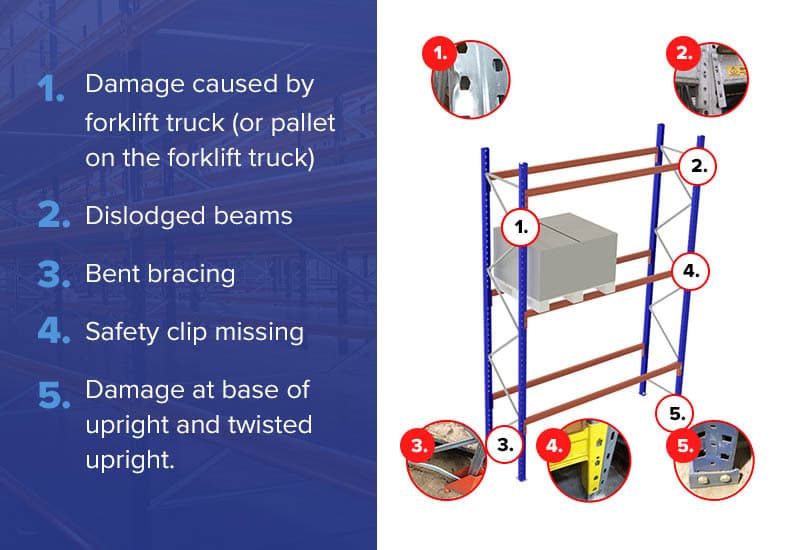
A thorough SEMA racking inspection is methodical and comprehensive. Inspectors work through the warehouse bay by bay, examining every component of the system. Here is what they are looking for:
Upright Posts and Frames
Uprights are the vertical columns that support the entire weight of your racking system. Inspectors check that uprights are perfectly vertical (any lean or twist is a red flag), free from significant impact damage, corrosion, or bending, and securely fixed to the floor via base plates and anchors. Even minor deviations from vertical can reduce load-bearing capacity, so inspectors use precise tolerances when assessing uprights.
Base Plates and Floor Fixings
Base plates distribute the load from the uprights to the floor. Inspectors check that base plates are flat, undamaged, and correctly positioned, that floor anchors are secure and torqued to the correct specification, and that there are no signs of floor subsidence, cracking, or movement around the fixings. Loose or missing floor bolts are a common failure point and must be addressed immediately.
Frame Bracing
Bracing provides lateral stability to the upright frames. Inspectors look for missing bracing components (which severely compromise stability), bent, twisted, or damaged bracing members, and loose or missing fixing bolts. Forklift impacts often cause bracing damage and should never be ignored.
Beams and Beam Connectors
Beams carry the pallet loads and must be correctly seated in their connectors. Inspectors check that beams are level and free from excessive deflection (sagging), that beam connectors are securely engaged and not damaged or deformed, and that beam safety locks are fitted to every connector. Safety locks prevent beams from being accidentally dislodged during loading and unloading - their presence is non-negotiable.
Safety Equipment and Accessories
Inspectors also examine additional safety provisions: column protectors and barriers (checking they are intact and correctly positioned), anti-collapse mesh or netting (ensuring it is secure and undamaged), and load notices (verifying they are present, legible, accurate, and displayed on every run of racking). Missing or illegible load notices are a common inspection finding and must be replaced.
General Warehouse Conditions
Beyond the racking itself, inspectors assess the wider warehouse environment: aisle widths (ensuring they are adequate for safe forklift operation), lighting (checking visibility is sufficient for safe loading and unloading), housekeeping (noting any obstructions, debris, or poor practices that increase risk), and overloading (identifying any bays where loads exceed the safe working load).
Understanding the Traffic Light Risk System
SEMA inspectors use a traffic light system to categorise the severity of any damage or issues identified during the inspection. This system provides a clear, at-a-glance understanding of priorities and helps you allocate resources appropriately.
RED Risk: Immediate Action Required
A RED rating indicates critical damage that presents an immediate risk of collapse or failure. Examples include severely bent or twisted uprights, missing or significantly damaged bracing, deflected beams beyond safe limits, or missing floor fixings that compromise stability.
RED-rated issues require immediate action. The affected bay must be offloaded, cordoned off, and taken out of service until repairs are completed. Do not delay - a RED rating means there is a real and present danger.
AMBER Risk: Action Needed Soon
An AMBER rating indicates damage that does not pose an immediate collapse risk but requires prompt attention. Examples include moderate impact damage to uprights, missing safety pins on beam connectors, minor beam deflection, or corrosion that has not yet reached a critical level.
An important operational point: AMBER-rated racking can continue to carry its existing load. However, once those pallets are removed, the affected bays must not be reloaded until repairs have been completed. AMBER damage that is left unaddressed will escalate to RED status - typically within four weeks. Treat any AMBER finding as a prompt to schedule repairs, not an excuse to defer action.
GREEN Risk: Monitor and Observe
A GREEN rating indicates minor issues that do not affect the structural integrity of the racking but should be monitored. Examples include superficial paint damage, minor scuffs or marks that do not compromise the metal, or small housekeeping issues.
GREEN-rated issues do not require immediate repair but should be monitored. If they worsen, they may be upgraded to AMBER or RED in future inspections.
What Happens After a SEMA Racking Inspection
Following the inspection, the SARI will provide a detailed written report. This document is both a compliance record and an action plan. A good inspection report should include a summary of findings, a traffic light breakdown of all issues identified, photographs of damaged components where relevant, and clear recommendations for remedial action, including timescales.
Your responsibility is to act on the findings. RED-rated issues must be addressed immediately. AMBER-rated issues should be scheduled for repair within the recommended timeframe. GREEN-rated issues should be logged and monitored during your regular in-house checks.
If the inspection identifies damage requiring specialist repair - such as replacing bent uprights or re-anchoring base plates - you will need to engage a competent racking repair service.
Keep a copy of every inspection report. In the event of an HSE investigation or an insurance claim, these reports provide evidence that you have met your legal obligations and taken reasonable steps to maintain a safe working environment.
How to Prepare Your Warehouse for a SEMA Inspection
A little preparation goes a long way. A well-organised inspection is quicker, more thorough, and produces clearer findings. Here is how to get your warehouse ready:
- Clear aisles and ensure the inspector has unobstructed access to all bays and uprights. Move pallets, equipment, or packaging that might block the inspector’s line of sight.
- Gather all racking documentation - original design drawings, installation certificates, load calculations, and previous inspection reports. The inspector may want to cross-reference these.
- Brief your warehouse staff. Let them know the inspection is taking place and ensure forklift operators give the inspector space to work safely.
- Compile a log of any recent incidents - forklift collisions, reported damage, or near-misses. These give the inspector useful context.
- Check that load notices are present, legible, and accurate. If any are missing or damaged, replace them before the inspection.
Good preparation demonstrates that you take rack safety seriously. It also streamlines the inspection process and ensures you get the most value from the inspector’s time.
Common Racking Failures Found During Inspections
Certain issues repeatedly arise during SEMA racking inspections. Being aware of these common failure points helps you take preventative action and avoid RED or AMBER ratings.
Impact Damage from Forklift Trucks
Forklift impacts are the single most common cause of racking damage. Even low-speed collisions can bend uprights, dislodge beams, or damage bracing. The solution is twofold: install column protectors and barriers in high-traffic areas, and invest in ongoing forklift operator training to reduce the frequency of impacts.
Missing or Damaged Safety Pins
Beam safety pins prevent beams from being accidentally knocked out of their connectors. They are small, inexpensive components - but their absence is a serious safety issue. Inspectors regularly find missing safety pins, often because they were removed during reconfigurations and not replaced.
Overloading Beyond Safe Working Loads
Load notices specify the maximum safe weight for each beam level and each bay. Overloading - whether deliberate or accidental - can cause beams to deflect, uprights to buckle, and in extreme cases, catastrophic failure. Ensure all warehouse staff understand load limits and enforce them rigorously.
Corroded or Deteriorated Components
In cold storage facilities, high-humidity environments, or warehouses storing corrosive materials, rust and corrosion can weaken racking components over time. Regular inspections catch this early, before it becomes critical.
Improper Modifications and Unofficial Repairs
Racking systems are engineered to specific tolerances. Unauthorised modifications - such as drilling new holes, welding repairs, or swapping components from different manufacturers - can compromise the system’s structural integrity. Any modifications or repairs must be carried out by a competent specialist and documented.
Missing, Damaged, or Inaccurate Load Notices
Load notices are a legal requirement, but they are often missing, illegible, or outdated. Replacing them is straightforward and inexpensive - there is no excuse for non-compliance.
SEMA Racking Inspections from United Storage Solutions

With over 45 years of experience in the racking industry, USS provides comprehensive, SEMA-compliant racking inspections to clients across the UK. We utilise a trusted network of fully qualified ‘technically competent persons’ as recognised by the HSE, including SEMA Approved Racking Inspectors (SARI), ensuring that every inspection meets the highest industry standards.
We inspect all common racking types - pallet racking, longspan shelving, cantilever racking, drive-in and drive-through systems, and specialised storage solutions. Inspections are thorough and methodical, producing clear, actionable reports using the traffic-light risk system.
A typical inspection for a medium-sized warehouse takes approximately a day on site, though this varies depending on the number of bays and the height of the racking installation.
Following the inspection, we provide a detailed written report that categorises all findings using the RED/AMBER/GREEN traffic light system, includes photographs of damaged components where relevant, and sets out clear recommendations for remedial action with realistic timescales. Reports are designed to be both legally compliant and practically useful - they tell you exactly what needs to be done and when.
If the inspection identifies damage requiring repair, we can provide a complete solution. USS offers professional racking repair services, including the replacement of damaged uprights, beams, bracing, and floor fixings; re-anchoring of base plates; installation of column protectors and safety barriers; and the supply and fitting of load notices. Working with a single provider for both inspection and repair simplifies the process and ensures continuity.
We also recognise that ongoing compliance is easier with a long-term partner who understands your operation. Many of our inspection clients work with us year after year, building a relationship that makes annual inspections straightforward and ensures we are familiar with your specific racking configuration and operational needs.
Book Your Racking Inspection Today
If your warehouse has not been inspected by an expert as defined by the HSE within the last 12 months, you are overdue. Don’t wait until an HSE visit or an incident to force your hand - get ahead of the requirement and discharge your legal obligations properly.
Contact the USS team today to arrange your racking inspection. We will work around your operational schedule, arrange a thorough inspection, and provide a clear, actionable report that gives you confidence in the safety and compliance of your racking system.
The information provided in this guide is for general informational and educational purposes only and does not constitute formal health and safety, legal, or professional advice. Racking safety requirements vary based on individual operational environments, equipment types, and warehouse layouts. Reading this guide does not replace the legal requirement for a routine physical racking inspection. As an official SEMA Approved Member, we ensure all our services align with the highest industry standards. Inspections are carried out across the UK via our trusted network of qualified independent ‘technically competent persons’, including SEMA Approved Racking Inspectors (SARI). To ensure your warehouse fully complies with PUWER 1998 and HSG76 guidelines, always arrange a formal, site-specific inspection.
This blog is for information purposes only and should not be construed as legal or financial advice and not intended to be substituted as legal or financial advice.
Content Form

Follow Us


- Custom Fabrications
- Racking & Shelving
- Self-Storage Units


